Friday, December 26, 2014

Thursday, December 25, 2014

Merry Christmas!

We must remember the true meaning of Christmas, that Jesus was born! So have a merry Christmas!

A Snowy Owl from the CBC

Wednesday, December 24, 2014

Weekly What Bird Wednesday

If you would like to join me for my W.W.B.W. leave a guess in the comments below or make your own weekly what bird post.

See how many species you can find in this large flock. Right click and click 'open link in new tab' for full sized image. This was at Silver Springs park this fall.
Leave your guess in the comments.
NOTE: I just figured out the image did not upload at full size, so it will be a lot harder than I thought.

Last weeks was a Magnolia Warbler

Saturday, December 20, 2014

Oak Hammock Marsh CBC 2014 Quick Post

This is not the full post for the Christmas Bird Count. Christian sent us just a few low quality pictures from the count that we took on his camera. He is going send the rest on a memory stick in the mail. Once they arrive I will make a full post.

Once at Oak Hammock Marsh we headed out with Christian. We saw a Snowy Owl almost right away!! It was the first bird we saw the day! And a lifer I have been seeking for all the time I've been birding.

We drove around seeing lots of great birds! Including White-winged Crossbills, also a lifer.

First Snowy Owl ever!!

 One of my favorite pictures, a pure white owl yawning.
Snowy Owl Yawning
 We saw a Great Horned Owl also.

Stay tuned for the full post!

Friday, December 19, 2014

Thursday, December 18, 2014

My Field Guides Update

Just a few days after I made the My Field Guide posts, our friends gave us back a bird guide they had been borrowing for a while. It was one we got from our Opa, and we let them borrow it when we got home from Ontario, so I hardly remember it.  A week or so after that, our friends in Alberta sent us some Christmas presents, including another field guide.

The one that our friends were borrowing was a Golden Guide to Field Identification of Birds. Here is the cover of the book.

It's an average field guide, with the drawings and maps beside. Occasionally it has a sonogram for a species.

The one our friends gave to us is the Ted Floyd Smithsonian Field Guide to the Birds of North America.


The thing I like about this one is that is has photos instead of drawings. We don't really have any books like this with just photos. The Birds of Canada Book has a small picture in the corner, which is unlabeled for which plumage it is. This is nice, because in some cases I like photos better than drawings.


The Ted Floyd Field Guide is from 2008, and as far as I can tell the other one is from 1986.

I should really get to the last Churchill post, so I hope it will be out soon.

Wednesday, December 17, 2014

Weekly What Bird Wednesday

If you would like to join me for my W.W.B.W. leave a guess in the comments below or make your own weekly what bird post.

Can you guess this bird from the summer?
Leave your guess in the comments

Last weeks, Bridget and Neil guessed correct, it was a female American Redstart.

Friday, December 12, 2014

Feathers on Friday

Here is a female Rose-breasted Grosbeak from the spring.
female Rose-breasted Grosbeak

Here's Prairie Birder's post.

Wednesday, December 10, 2014

Weekly What Bird Wednesday

If you would like to join me for my W.W.B.W. leave a guess in the comments below or make your own weekly what bird post.

Can you guess this weeks bird? Leave your guess in the comments.


Last weeks was a Common Redpoll.

Sunday, December 7, 2014

My Field Guides

Here is a stack of just about all my field guides. As you can see, even if the internet cuts out and I can't look up any bird I want, I'm pretty well equipped, even for mammals, butterflies and flowers. We also have a few star guides which I haven't included. Many of these field guides came from my Opa when he passed away. He always enjoyed watching the birds out the window and kept them well stocked with food. The duct taped and tattered one is the one our family has had for a long time, then we later got Birds of Canada. That was even before I became really interested in birds.
I was kindly given the National Geographic Field Guide to Birds of North America, The Warbler Guide, and the Sibley Guide to Birds. 

My Field guides

After some time deciphering what year they were published, I lined them up in as best order I could get. I accidentally placed a 1980 book before some others, but oh well. If you happen to know if I any dates wrong please comment to let me know. I don't know if I got correct dates for all of them, but as far as I could find, these are the dates. The books span over 100 years (if I got the dates correct)!! From a 1913 flower guide to 2014 Sibley Guide to Birds.
My field guides lined up in the order of years.

Now for pictures inside of all of these guides:


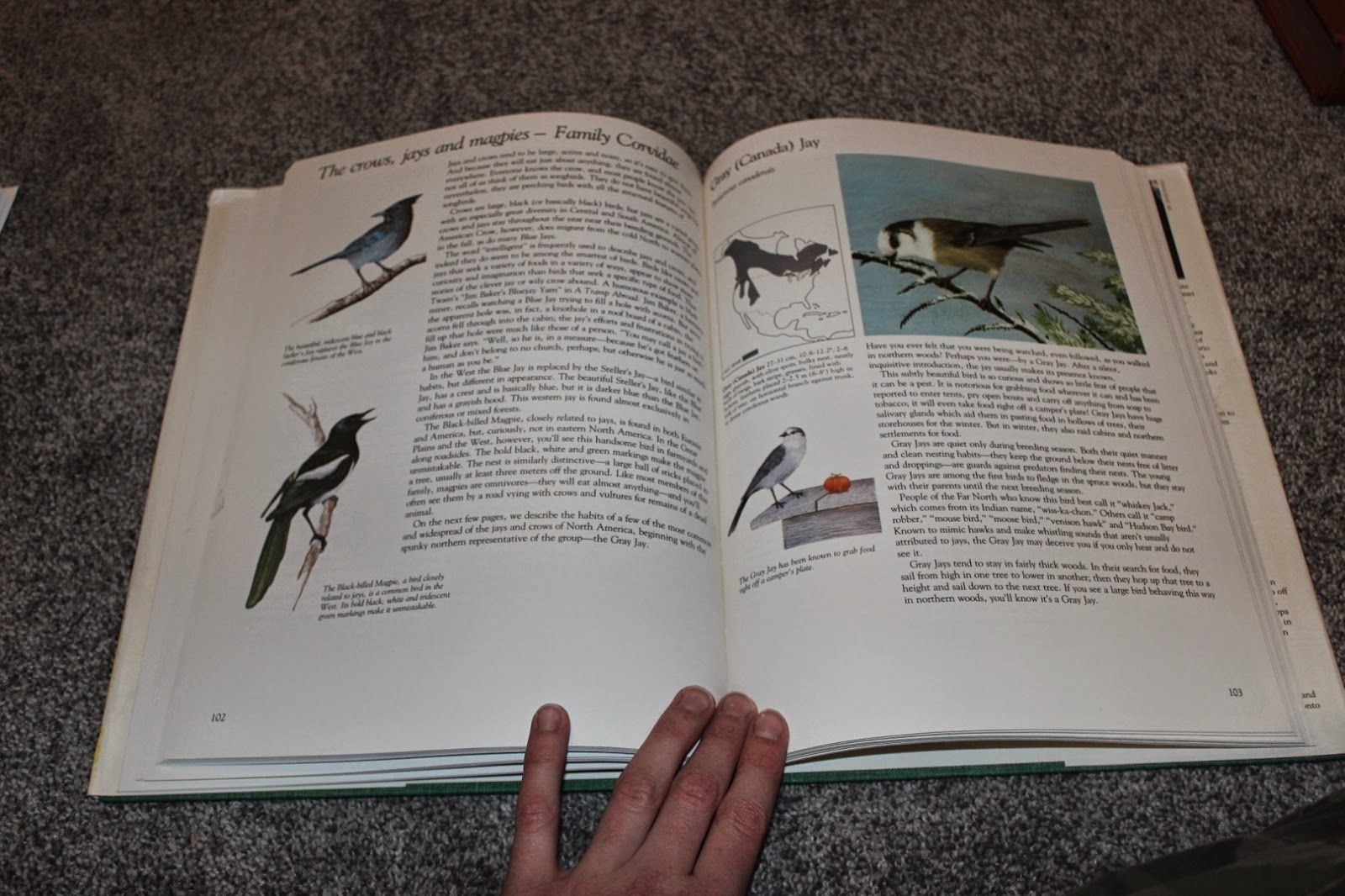
This is the Book of North American Birds. My brother got it at a thrift store for me. It is a pretty good guide, with plenty of information on each bird and a range map. Though I haven't actually used it for identifying birds, the thing that I find annoying is that they sometimes group two similar species together and only have a picture for one.


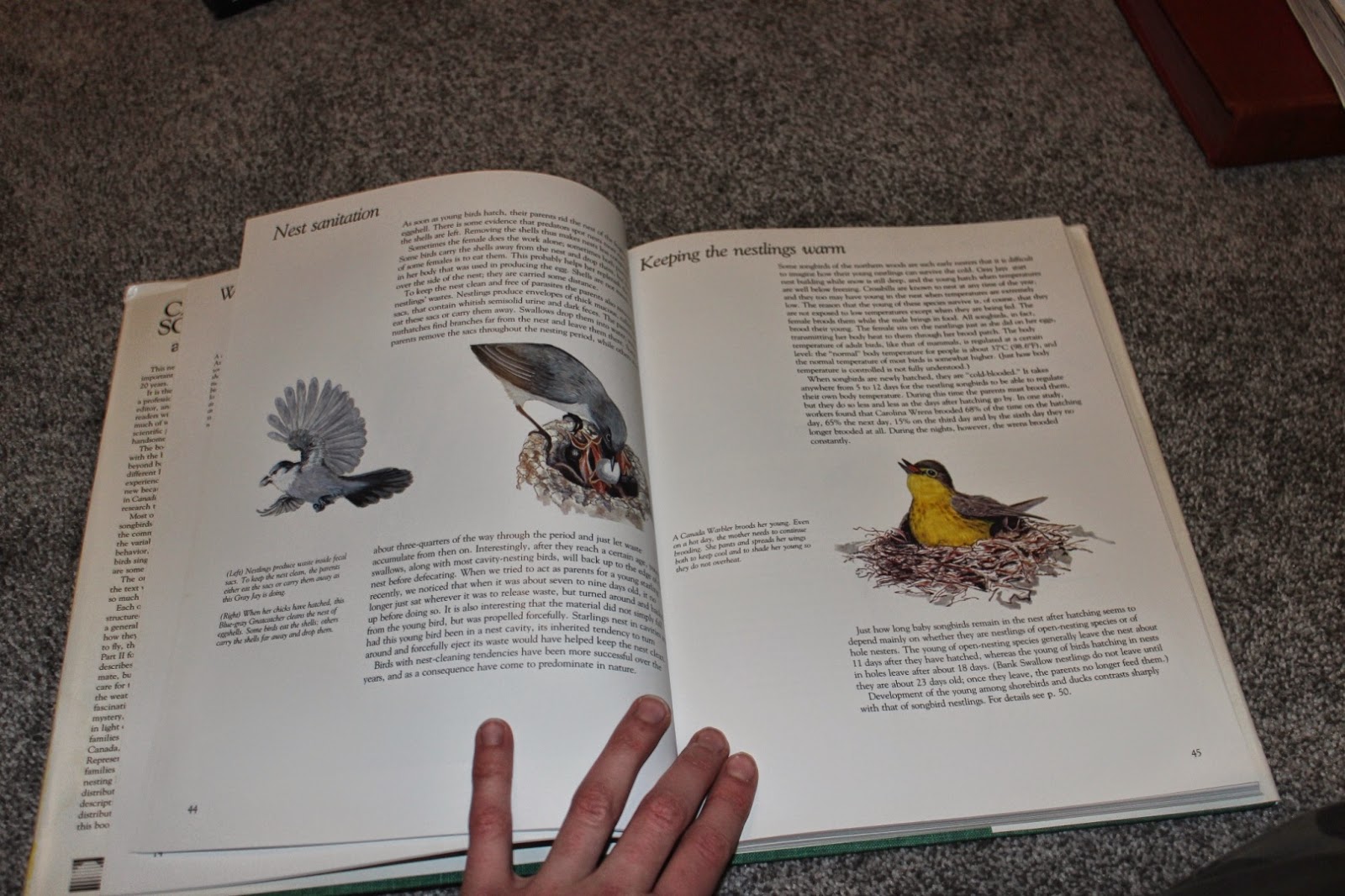
This is Canadian Songbirds and their Ways. The beginning section is about the behavior of songbirds and the second part is for actual individual species. This is the first section
The second section.
This is my latest addition, the Sibley Guide to Birds. I find the paintings of many different plumage's very handy. Definitely now one of my favorites.

Lone Pine's Birds of Canada is one of my favorite also, with easy color's separating different families I find it very easy to quickly find the birds you're looking for. It provides a plenty of information on each bird, nesting, habitat, id, a drawing and a photograph. The letdown of this book is that it often has lack of plumage's and pictures for identifying, and it doesn't label the photo if it is a juvenile, female, male or something like that.


My oldest bird guide, another guide to birds of Canada. It provides a wealth of information, with pages of writing. New guides mostly just have pictures. while this one mostly just has writing. It has so much about each bird, it shows the subspecies for some, the talons of eagles and hawk and details of things new field guides wouldn't have. Of course I'm sure you can get other books for this type of stuff, and I don't know how much this is a field guide rather than for studying about birds.

Here it shows the pages of writing, with small sketches of the head or tail of a bird for field marks.

This is yet another birds of Canada bird. It's very big and heavy, and has a lot of writing and details of individual birds like the one above.
I really like these full page colorful drawings of different species.
Here is the 1913 (as far as I can tell) flower book. 

The Mammals of Canada book, I really like this, it shares many similarities with the Lone Pine Birds of Canada, seeing it was printed by the same company. It has the color separated families for quickly finding the animal you want. It has lots of material on every species, always with a drawing and usually a photo. It often has two or three pages on each species.

Here is the Audubon Society Field Guide to North America. The first section is all photos of the species, good for side by side comparisons, while the end section is the range map and a bit of information on each species.


This is the good ol' Ield Guide to Birds st of the Rockies, Ger Tory Peterson as it now reads on the front cover have covered by duct tape to hold it together. The Field Guide to Birds East of the rockies is a good book, with drawings of male and female birds often with different plumage's also. But to see the range map you have to flip to the back and find it.


This is as very small handheld simplified Peterson First Guide to Birds book. It has one drawing of each bird and a bit of information.

Half the pages are falling out of the Peterson Field Guide to Western Birds, but other than that it's actually in pretty good condition. The cover isn't in bad shape, and the pages looks decent, but as soon as you open it pages spill out.

This is a Peterson Field Guide to Wildflowers, other than that I don't know much about it,

The National Geographic Field Guide to the Birds of North America has been well used ever since Christian Artuso gave it to me when we first met. There are handy thumb tabs for some of the big groups of birds. It has some information about the birds, and some excellent drawings usually of a few different plumage's.

The Manitoba Wayside Wildflowers is a handy book to have along if you're going birding or something if you want to identify any flowers.

If you're going to Churchill, the Wildflowers of Churchill is a very good book for identifying wildflowers there. When two of my older brothers went to Churchill a few years ago with my dad, they brought this book and identified and made a pressed collection of flowers.


And that is basically all that big pile of field guides. Though I seem to have forgotten to take pictures of the Butterfly book. But I've never used it before, I just have it in the collection,

So keep checking back for any other posts!

Friday, December 5, 2014

Feathers on Friday

My brother saw some Red Crossbills the other day and managed some pictures. It was a lifer for him, and I have also never seen one, so I'm hoping they'll show up again.
Red Crossbill in evergreen trees.

Here is Prairie Birder's post.

Thursday, December 4, 2014

Weekly What Bird Wednesday

If you would like to join me for my W.W.B.W. leave a guess in the comments below or make your own weekly what bird post.

Can you guess this bird? Leave your guess in the comments.


Last weeks were actually House Sparrows.

Monday, December 1, 2014

Winter Birding

Winter is finally here. We just got a dump of snow a few days ago. Winter birds are settling in, Redpolls, Blue Jays, ravens. I haven't really been birding much in the last while, or making a lot of posts other than Feathers on Friday and Weekly What Birds, so this morning I went out and watched the birds at the feeder. There have been three finch species hanging around, Common Redpolls, American Goldfinches and Pine Siskins. I saw them all today at the feeders.

Chickadees of course are the most common and the boldest as I sat on the deck. They were always flitting back and forth from the feeders, while the redpolls and siskins took a long time for them to gain my trust and start feeding.
Black-capped Chickade

Black-capped Chickadee
 The chickadees hid seeds in the bark of the trees and store them for later.
Black-capped Chickadee
 Eventually the redpolls came warily closer, if I made a move they would fly. After several attempts for the feeder and seeing I wasn't moving a lot, they became comfortable with me and the flock came in.
Common Redpoll
 Last year we scarce had redpolls at all, so it's a treat to have them back.
Common Redpoll getting ready to fly down to the feeder.
 The siskins chorused in the nearby trees but didn't dare to come near.After waiting quite a while and seeing the siskins weren't coming, I started to leave. I waited a moment and came back. Already a whole bunch of sisksin were at the feeder. I cautiously approached and leaned on the deck rail to get closer.
Pine Siskin
Pine Siskin

A Downy Woodpecker came around later on a close branch, and I got a pretty good photo.
Downy Woodpecker
 After being inside a few minutes, my brother said there was a big bird at the feeder. He got a bit of a blurry picture before it flew away. It looked like a Rusty Blackbird. Five minutes later it returned. I was able to get a decent picture of it under a chair.
Quite the bird! It's a lifer for me, and I didn't expect to see it here in the winter, nevermind at our feeder.
Rusty Blackbird

I am planning to make some new posts soon, the final part of the Churchill trip, a post about my field guides, and I should be making others. So stay tuned!